

I’ve heard the word “premium” thrown around so much it barely means anything anymore.
Premium this. Premium that. Slap it on a product description and charge an extra hundred bucks. Half the time the only thing premium is the price tag.
But real premium construction? That’s different. That’s not marketing. That’s something you can see, feel, and wear for years. Something that separates a jacket that lasts from a jacket that doesn’t.
I’ve been in the leather business over ten years at The Leather Jackets. Sold to thousands of people worldwide. Handled jackets at every price point. Learned what actually matters and what’s just hype.
Here’s what premium construction actually means for your bomber jacket.
What Does Premium Construction Actually Mean
Premium construction means every part of the jacket is made with higher standards than necessary so it performs better and lasts longer than basic jackets.
Think of it like building a house.
Basic construction meets code. It’s fine. It’ll stand up. But the drywall might have seams you can see. The trim might have gaps. The cabinets might be particle board instead of plywood. It works but it’s nothing special.
Premium construction is different. The drywall is smooth because they took time taping. The trim fits tight because they measured twice. The cabinets are solid wood because they didn’t cut corners. You notice the difference even if you can’t say why.
Same with jackets.
Basic construction uses enough stitching to hold it together. Uses standard zippers. Skips reinforcement because it takes time. The jacket works but it’s nothing special.
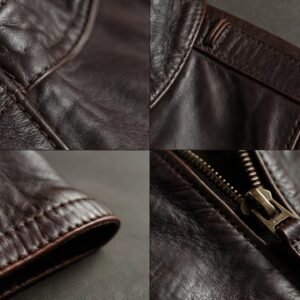
Premium construction uses more stitches per inch because it’s stronger. Uses heavy zippers from YKK because they last. Adds reinforcement at stress points because that’s where jackets fail. Finishes edges so they look clean and don’t fray.
You notice the difference over time. The jacket holds its shape. The zipper doesn’t jam. The pockets don’t tear. It just works for years.
What the Stitching Tells You About Quality
Stitching is the bones of the jacket. Hold everything together.
Premium stitching starts with thread. Good thread is strong but not stiff. Resists UV damage so it doesn’t weaken in sunlight. Holds up to abrasion so it doesn’t fray.
Then stitch density. More stitches per inch means stronger seams. Means each stitch carries less load. Means if one stitch breaks, the ones next to it hold. Cheap jackets use fewer stitches to save time. Premium uses more.
Stitch consistency matters too. Look at the seams. Are they straight? Are the stitches even length? Any skipped stitches? Any loose threads?
On a premium jacket, the stitching is clean everywhere. Even on parts nobody sees. Even inside where only you’ll ever look.
On a cheap jacket, the stitching might look okay from across the room but falls apart up close. Wonky lines. Uneven stitches. Thread hanging loose.
Our womens bomber leather jacket uses high stitch density throughout, including inside seams most people never see.
How Reinforcement Changes Everything
Here’s where premium construction really shows.
Certain spots on a jacket take more stress than others. Pocket corners. Shoulder seams. Zipper ends. Button attachments. These are where jackets fail first.
Premium construction reinforces these spots. Bar tacks at pocket corners. Extra stitching at stress points. Backing washers on buttons. Stabilizer tape in shoulder seams.
You don’t see any of this when you buy the jacket. But five years later when the jacket still looks good and nothing has ripped, that’s why.
Cheap jackets skip this stuff. Saves time, saves money. But pocket corners tear. Shoulder seams stretch. Buttons pull out. The jacket fails where it should have been reinforced.
What Hardware Quality Actually Means
Zippers, snaps, buttons. You touch these every time you wear the jacket.
Premium hardware starts with the zipper. YKK is the standard. They make billions of zippers and they’re reliable. But even YKK has different quality levels. Premium jackets use their heavy duty line, not the basic stuff.
Pull the zipper up and down. It should glide smooth. No catching. No grinding. Should feel substantial in your hand.
The zipper pull itself matters too. Metal, not plastic. Should have some weight. Should be attached securely.
Snaps should close with a clean click. Should feel solid, not loose. Should stay closed until you want them open.
Buttons should be attached with backing washers so they don’t pull through the leather. Shouldn’t wiggle.
All this hardware should match. Same finish, same quality, same attention.
What the Lining Reveals
Lining isn’t just for comfort. It’s part of the construction.
Premium lining starts with material. Cupro, viscose, bemberg, or high quality satin. These breathe. They slide over your clothes. They don’t pill or tear.
Cheap lining is polyester. Grabs your clothes. Makes you sweat. Pills after a few washes. Tears easily.
Then attachment. Premium lining is attached smoothly. No pulling. No wrinkling. No loose sections that can catch.
The way lining attaches at the hem and sleeves matters. Should move with the jacket, not against it. Shouldn’t pull out when you take the jacket off.
Some jackets have lined sleeves but not lined bodies. That’s a cost cut. Premium jackets line everything.
How the Collar Keeps Its Shape
Collar is the first thing people notice. Needs to hold up.
Premium collars have interfacing inside. That’s a layer of stiffening material between the leather and lining. Keeps the collar from flopping over or getting wavy.
Some collars are cut on the bias. Diagonal to the grain. Gives them more flexibility to curve around your neck.
The collar stand, the part that goes around your neck, should be tall enough to support the collar without choking you. Should be stitched so it stands up when you want and lays flat when you don’t.
Cheap jackets skip the interfacing. Collars go limp after a few wears. Looks terrible.
What Shoulder Construction Does
Shoulders make or break how a jacket feels.
Premium shoulder construction uses set-in sleeves. That means the sleeve is sewn into an armhole, not cut as one piece with the body. Allows more shape and movement.
The sleeve cap, the top curve of the sleeve, should have just enough ease to let you raise your arm without pulling the whole jacket up. Too much ease and the sleeve wrinkles weird. Too little and you can’t move.
Shoulder seams should sit right at the edge of your shoulder. Not hanging off. Not creeping toward your neck. That takes precise pattern cutting and careful sewing.
Some premium jackets add shoulder pads or shaping for a sharper look. Not bulky pads, just enough structure to define the shoulder.
A jacket with bad shoulder construction fights you every time you move. Premium construction you forget you’re wearing.
How the Back Panel Affects Fit
Look at the back of a bomber jacket.
Some have a single panel. Simple, clean, but less shape.
Premium construction might use a center seam. Allows the jacket to curve with your spine. Fits better, moves better.
Some have pleats or gussets at the shoulders. Extra fabric that opens up when you reach forward. Great for movement.
The back should have enough room for your shoulder blades without looking baggy. Shouldn’t pull across the back when you bring your arms forward.
This is where pattern cutting and construction meet. The shape is built in from the start, not forced by stretching.
What the Waistband and Cuffs Do
Ribbed waistband and cuffs are signature bomber features.
Premium ribbing is dense but stretchy. Military spec. Snaps back when you pull it. Holds its shape wear after wear.
Cheap ribbing gets loose fast. After a few washes it’s baggy. The jacket loses its shape and looks sloppy.
The way ribbing attaches matters too. Should be sewn on securely, not just tacked. The seam where ribbing meets leather should be smooth, not bulky.
Some premium bombers use leather waistbands with elastic inside. Different look but same principles. Elastic should be strong. Attachment should be secure.
Our mens bomber leather jacket uses military-spec ribbing that holds its shape for years.
How Pockets Are Constructed
Pockets get used hard. Keys, phone, wallet, hands. They need to hold up.
Premium pockets have reinforcement at the corners. Bar tacks or extra stitching where stress is highest.
Pocket bags should be deep enough to actually hold things. Should be made of durable material, not cheap muslin that tears.
Zippered pockets need the zipper attached securely. Flap pockets need the flap to lay flat, not gape open.
Hand pockets should be positioned so your hands fall naturally. Too low and you have to reach down. Too high and they’re useless.
Some premium jackets line pockets with softer material so your hands are comfortable. Small touch but noticeable.
What Edge Finishing Tells You
Look at the edges of the leather. On sleeves, pockets, plackets.
Raw edges fray and look unfinished. Premium construction finishes these edges. Sometimes they’re folded under and stitched. Sometimes they’re painted or inked to match the leather.
Edge painting is a skill. Should be smooth, even, bonded to the leather. Not cracking, not peeling, not slopped on.
Finished edges tell you someone cared about the details. Unfinished edges tell you they rushed.
How the Pattern Cutting Matters
Before any stitching happens, the leather has to be cut.
Premium cutting matches the pieces to the right parts of the hide. The back panels come from the strongest, cleanest sections. The sleeves come from areas that need more flexibility. The collar and pockets use smaller pieces but still need to match.
The pieces have to be cut so they line up when sewn. The front panels should mirror each other. The sleeves should match left and right. The shoulder seams should meet the armholes smoothly.
If the pattern is off, nothing else matters. The jacket will never fit right no matter how good the stitching is.
What All This Means for You
Premium construction means the jacket works.
It fits right because the pattern is right. It moves with you because the shoulders are built right. It stays together because the stitching and reinforcement are right. It looks good over time because the materials and construction hold up.
You don’t think about any of this when you’re wearing it. That’s the point. The jacket just does its job without fighting you, without failing, without looking tired after a year.
Cheap construction you notice. Zipper catches. Seam pulls. Collar flops. Lining tears. You’re constantly aware of the jacket because it’s constantly annoying you.
Premium construction you forget. Until someone says “nice jacket” and you remember you’re wearing something good.
The Bottom Line on Premium Construction
Premium construction isn’t about labels or marketing words. It’s about how the jacket is actually put together.
More stitches per inch. Reinforcement at stress points. Heavy hardware that lasts. Lining that breathes. Edges that are finished. Pattern cutting that fits.
All of this costs more. Takes more time. Requires more skill. But the result is a jacket that lasts for years instead of months. That looks better over time instead of worse. That you actually want to keep wearing.
At The Leather Jackets we’ve been at this over ten years. Thousands of customers worldwide. We know what premium construction means because we’ve been doing it long enough to see what holds up.
We’re in Des Plaines, Illinois. 341 W Kathleen Drive. Questions about construction quality? Call +16182706312 or email care@theleatherjackets.com.
Happy to talk about what makes a jacket worth owning. No pressure. Just honest talk about how things are built.